1. Focus on Intent vs Keywords
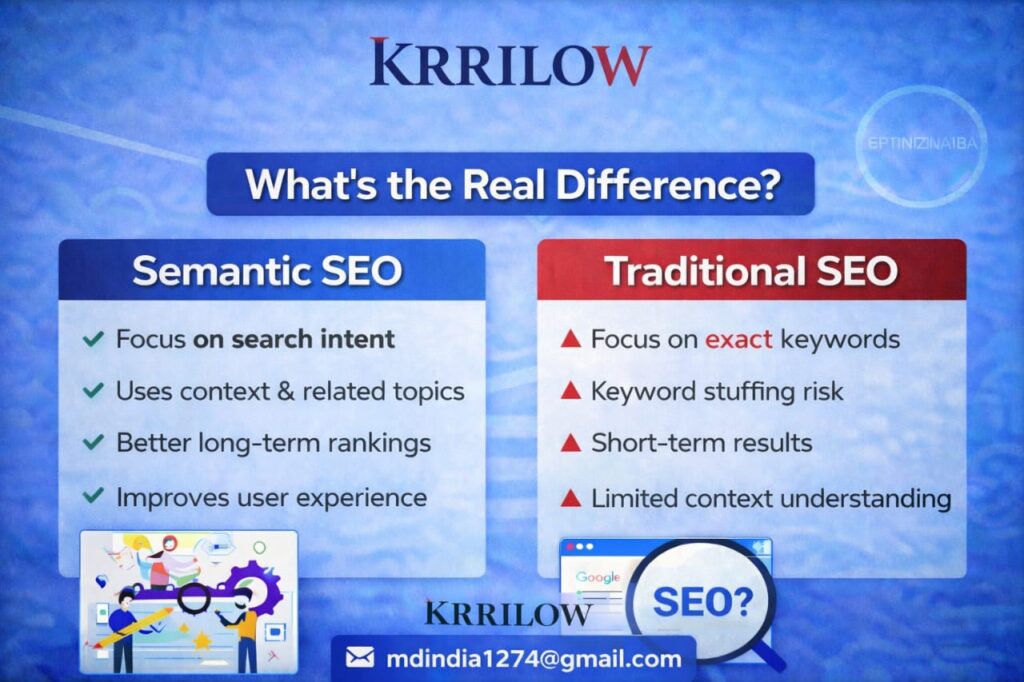
Traditional SEO largely hinges on the use of a particular keyword to garner higher rankings on search engines. Meanwhile, Semantic SEO doesn’t stop at the surface layer of optimization but rather dwells on the user intent and the contextual meaning of the search query. It doesn’t just target the phrases; instead, it examines the relationships between words, topics, and the way users search. At Krrilow, we use semantic SEO techniques to enable businesses to rank more efficiently by figuring out what users really want. Take, for instance, the case of e, commerce services in Jaipur, which can rank product, related searches by aligning with user intent rather than sticking to the exact keywords. The engagement gets better as a result of this intent, driven approach, the accuracy of search results improves, and there is sustainable digital growth.
2. Content Understanding
Traditional SEO methods usually rely on the use of keywords and meta tags to improve rankings. On the other hand, Semantic SEO revolves around how search engines understand the entire content. It goes back to the significance of context, topical relevance, and the links between different entities in the content. Instead of overusing keywords, structured and meaningful writing yields better results. SEO service providers companies in India like Krrilow, can leverage this approach by creating authentic, intent, focused content that not only meets user queries but also enhances search visibility in a sustainable way.
3. Search Engine Algorithms
Traditional SEO mainly focused on improving a website through basic ranking factors such as backlinks and keyword placement. In contrast, Semantic SEO aims to be aligned with complex AI, based, concept, understanding type search engine algorithms that can understand concepts, synonyms, and related terms.
An example of a semantically optimized web development company is Krrilow, which not only structures the content in a logical manner but also uses schema markup and provides the correct context to products and services. This approach results in websites getting higher rankings in voice search, featured snippets, and knowledge panels, thus attracting more visibility from modern search platforms.
4. Keyword Strategy
Traditional SEO is very much dependent on the exact matching of keywords. Semantic SEO, however, works with topic clusters, synonyms, and related words to make content more friendly. In addition, Semantic SEO can actually focus on a related question such as “how to increase online presence” instead of just “the best digital marketing service.” Thus, it is basically a more enriched network of meaning. Topical optimization, which is one of the elements of semantic SEO, is very effective in getting more authority when talking about SEO services in India. It helps search engines to spot and link several closely related topical concepts that in the end open up a broader topic.
5. Role of Schema Markup
Structured data was one of the least prioritized aspects of traditional SEO. But, with Semantic SEO, it is imperative for search engines to have the assistance of schema markup to understand the content.
Schema is a way of classifying the different elements like people, products, services, and reviews, so that the information becomes clearer for Google. Professional web development company like Krrilow will utilize schema markup to enhance the visual appearance of your website in the search results. Consequently, this leads to an increase in rich results, better visibility, and higher click, through rates.
6. User Experience
Traditionally, SEO was largely about making minor adjustments to content so that it would be more attractive to algorithms, ranking factors, and bots. Semantic SEO, on the other hand, is a user, centered strategy that aims at providing content that is logical, relevant, and that, ultimately, adds value. These are all, basically, enhanced by the factors of accessibility, readability, and overall usability.
By way of illustration, e, commerce sites have to generate content that not only provides the answers to the users’ questions but also guides them through the site in a seamless manner. Such websites, therefore, lead to lower bounce rates and longer dwell timeswhich, actually, are the most crucial metrics of user engagement that is good, as well as, of enhanced organic rankings.
7. Link-Building Approach
Traditional SEO used to measure success mainly through the amount of backlinks a website had. Semantic SEO, on the other hand, emphasizes link quality and link relevance more than the number of links. It is a little less concerned with authority and more with the context and the credibility that come from the linked content. Take for instance, links from niche, related blogs or forums. They are more meaningful in a semantic sense compared to general backlinks. By using digital marketing services, semantic SEO can be a very effective way of gaining the trust of the users, becoming more relevant in the eyes of the topical search engines, and showing the expertise.
8. Voice Search Optimization
Voice search queries typically take the form of a conversation and are strongly oriented towards the user’s intent. This fact alone gives Semantic SEO a substantial edge over conventional SEO techniques. When a company optimizes its content to be understood in natural language, it can then correspond to the users’ way of speaking instead of their way of typing. As a result, companies, like those who are collaborating with Krrilow, become more easily found through voice assistants and a variety of digital platforms, hence, their visibility gets strengthened in the contemporary search ecosystem which is based on the principles of the network theory.